

FRONT PAGE
Rexcapade!
Tyrannosaurus escapes from Dinosaur Hall
S T Y L E
A New T.rex
With a New Attitude
Carnegie Museum preparators offer a new look for an old friend.
From Carnegie Magazine

|
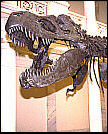
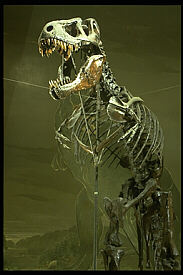
| Alleged scavenger T. rex refused to comment on eating habits. |
Cory Thysorus
Mirror Exclusive
With an average length of nearly 40 feet and a weight estimated at six and a half tons, Tyrannosaurus rex was one big animal! However, bigger isn't always better. Although it towered over most dinosaurs, T. rex's humongous size posed problems.
T. rex's movement was limited by its dino-girth. It wasn't exactly a speed demon. Its maximum velocity was about 20 m.p.h., comparable to that of today's land giant, the African elephant.
Size and weight also made Tyrannosaurus a clumsy beast. The dinosaur could easily lose its balance when moving at a high speed. Its tiny front arms weren't enough to stabilize a freefalling rex, and it was in great danger of fracturing its heavy skull if it fell. It could also easily be knocked off balance by struggling prey.
Some paleontologists suggest that the difficulty in capturing prey negates the classic interpretation of Tyrannosaurus rex as a predatory animal. They suggest that the huge carnivore was a scavenger, surviving on the remains of animals that were already dead. The answer may lie somewhere between the two extremes. T. rex may have indeed been a predator, but only took sick or weak animals that didn't put up much of a fight.
However, it is highly likely that the tyrant king wasn't above taking it easy and making a hearty meal of a carcass whenever it could. It's a shame that T. rex was felled by extinction—American highways would have provided a coast-to-coast buffet!
