




1.
Diplodocus carnegii
"Dippy"
2.
Squatina alifera
"Ancient Angel Shark"
3.
Gyrodus circularis
"Extinct Parrot Fish"
4.
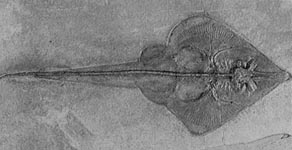
Blemnobatis sismondae
"Extinct Banjo Fish"
5.
Clidastes propython
Mosasaur
6. A Cretaceous Ammonite
7.
Protoceratops andrewsi
Protoceratops
8.
Prototostega gigas
"Giant Sea Turtle"
9. T. rex
10.
Rhamphorynchus munsteri
Pterosaur
11.
Apatosaurus louisae
Apatosaurus
12. Stegosaurus
ungulatus
Stegosaur
1. Did you
know that this was Carnegie Museum's first dinosaur? Dippy was even
named after Andrew Carnegie!
This skeleton
is made up of real fossilized dinosaur bones, which were dug up in the
western United States. Scientists
brought the bones to our museum to put Dippy together.
Diplodocus
ate plants and was alive about 147 to 137 million years ago.
2. This
is a shark fossil. Sharks lived in the sea at the same time dinosaurs
lived on land. Some sharks were even around long before dinosaurs!
Most of a shark's
skeleton is made of cartilage (like the material in the bridge of your
nose). Cartilage is softer than bone, and it is less likely to become
a fossil. The hard parts of an animal are the most likely to become a
fossil--the bones and teeth. We feel lucky to have this shark fossil!
3. This
is the fossil of a bony fish. Many creatures that resemble this ancient
fossil are swimming in the seas today.
The hard parts
of an ancient fish--its bones and scales--became fossilized, but its
soft parts--eyeballs and stomach--usually didn't.
4. This fish lived on the bottom of an ancient ocean. It had a flat body and expanded front fins. It ate squishy, boneless animals from the ocean floor. Its closest living relative is called a "Banjo Fish."
5.
This animal is called a mosasaur.
Mosasaurs were not dinosaurs: they were swimming reptiles.
They lived at the same time as dinosaurs, ancient fish and sharks.
Mosasaurs were predators. They had pointed narrow teeth and an extra joint in their lower jaws, which allowed them to swallow large creatures. Mosasaurs are probably related to monitor lizards, such as the Komodo Dragon that lives today on an Indonesian island.
This fossil is about 12 feet (about 4 m) long!
6. This is the fossil of an ammonite. Ammonites lived in the ancient oceans and floated with the currents. Their shells came in many unusually coiled shapes. Most ammonites became extinct at the same time as the dinosaurs, but they have a living relative: the chambered nautilus.
7. This is the fossilized skeleton of the dinosaur Protoceratops. It lived at the same time as the mosasaurs (swimming reptiles) and some giant sea turtles, but in a different part of the world. More than one hundred Protoceratops fossils have been collected in the region we now know as Mongolia.
This is a small dinosaur. Most adult Protoceratops grew to be about 5 or 6 feet (1.5 m) long.
8. This is a giant turtle that lived in the ancient oceans. Its shell is 3 feet, 11 inches (1.17m) long. Its strong, flipper-like limbs suggest that it was a powerful swimmer. The large openings you see in the shell made it possible for the turtle to be very large without extra weight. The shell probably had a leathery covering, and it may not have been able to pull its head and limbs inside the way some land turtles can.
9. Tyrannosaurus rex was a large, meat-eating dinosaur. When paleontologists first assembled this skeleton, they thought that T. rex stood upright and dragged its tail. However, since no drag marks have been found with fossilized T. rex footprints, scientists have changed their minds about how T. rex might have walked.
10. Pterosaurs
were a group of winged reptiles that lived at the same time as the
dinosaurs. They are now extinct, but when they were alive they came in
many types and sizes! Some are smaller than a pigeon and one is 35 feet
(9 m) from wing to wing!
Pterosaurs
had hollow bones, making them as light as possible for flight. Scientists
are still trying to determine whether pterosaurs flapped their wings to
take off or if they could only glide from high cliffs and trees. Some
features of the pterosaurs are similar to birds, which is of great interest
to scientists.
11. Have you ever heard of a "Brontosaurus?" Scientists had found two very similar types of dinosaur and given them two different names: Apatosaurus and Brontosaurus. Later, they figured out that they had collected several different sizes of the same type of dinosaur. One of the rules about scientific naming is that the first name someone comes up with is the official name. Since someone thought of "Apatosaurus" before someone else thought up "Brontosaurus", the creature you see above will never be known as a Brontosaurus again!
12. This strange skeleton comes from a plant-eating Stegosaurus. It has a tiny head with little spiky teeth along its jaw. It might have had a beak-like structure instead of front teeth. Stegosaurus has a spiky tail . . . do you think it used its tail to attack other animals or to protect itself?